

Carbon Centurions is the first project coming out of Covid and builds on our share our experience in amateur cricket in wider communities.
Our aim to help 100 Cricket Clubs become Carbon Balanced in 100 Days.
How? By recruiting, training and supporting 100 Carbon Champions to help their clubs measure, reduce and balance their carbon emissions. The below provides more information and is just one of many tools used to support Champions and Sponsors.
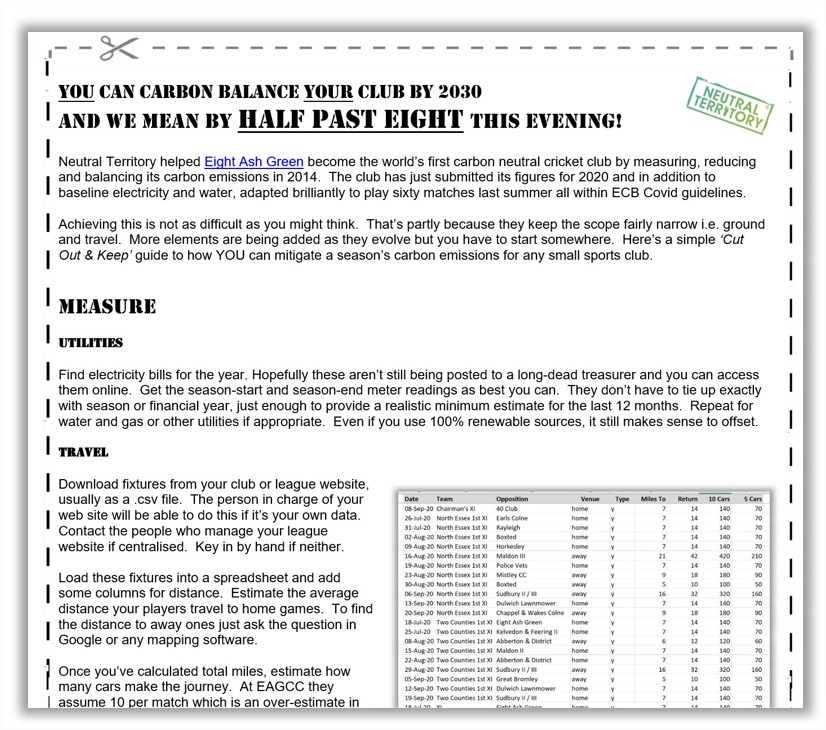
Click to download your Cut Out & Keep copy!
We plan to use Carbon Balancing as the key to unlock positive action. Carbon balancing means offsetting unavoidable carbon emissions by keeping or creating natural environments which not only absorb the emissions but provide the eco-diversity and wildlife benefits too.
The longer term aim is is to provide a solution that can scale to ANY community. We’re starting with small cricket clubs but once proven, it should be able to work anywhere. We don’t want to tell communities what to do, just provide the guidance they need to enable to take positive action.
The disruptive element is to flip the focus from organisations to individuals. The ability to measure and balance needs to be independent of authority. The key to this and scaling it up lies with people and processes / techniques and tools. Ideas from Big Data will help here.
By working at grass roots and aggregating upwards, there is flexibility to allow people to define their own communities. These might be existing e.g. Two Counties Cricket League or informal e.g. the residents of a cul-de-sac. Who are we to tell them how to organise themselves?
We will also use the community for support e.g. the Giff Gaff agents model. And possible the Linux community for software to automate routine, repetitive chores like measurement and to provide support (portal) and promote (social media).
Our Measure – Reduce – Model has switched to Measure – Balance – Reduce to offer and deliver Positive Action. The Positive Deviance 4D process has more to contribute at the Reduce stage when there is more variability and sharing ideas will add most value.
The change reflects our earlier research which suggests the combination of causes needed for a successful IT intervention. Ten years on, MRB model changed completely due to technology and audiences. Top down, internal control driven models are outdated.
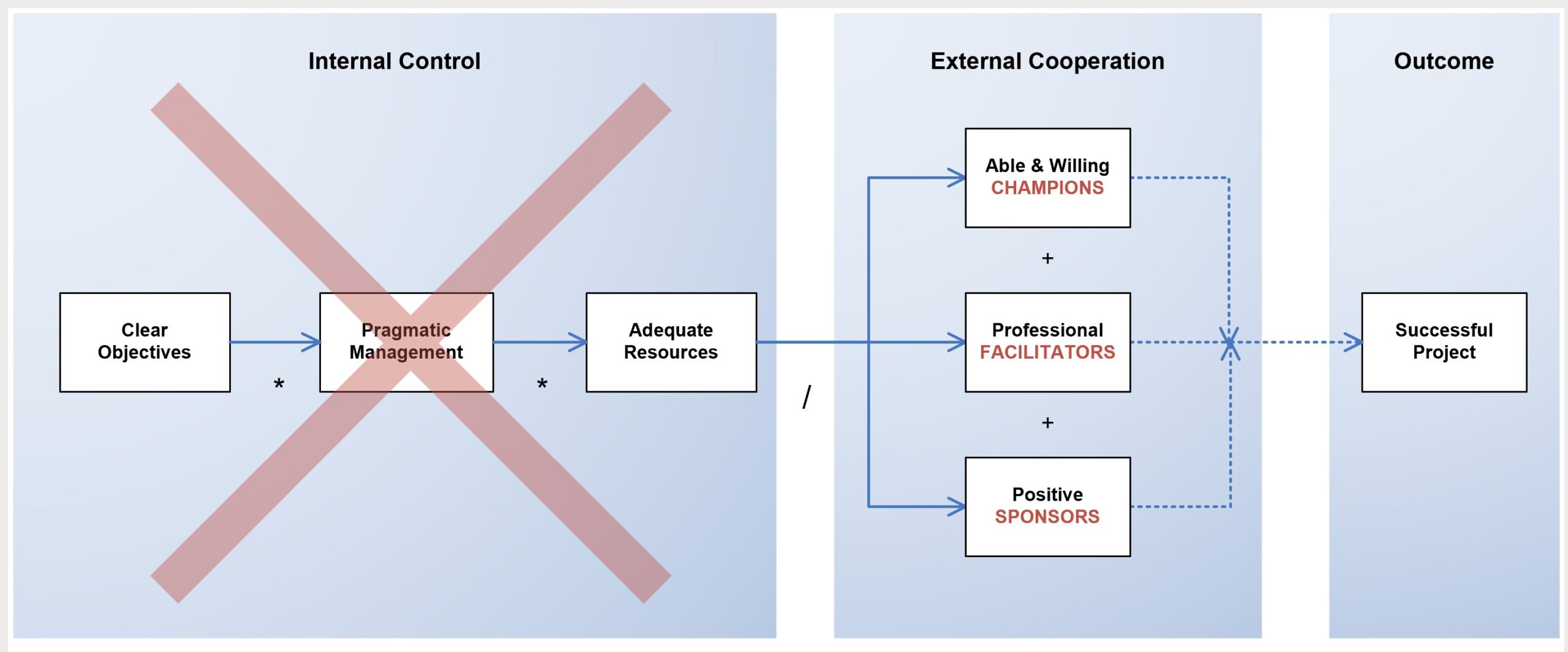
Able & Willing Champions (aka Outliers / Influencers / Positive Deviants). Willing means (preferably young) people who are already motivated to take action. Able means they are provided with effective learning to understand how they can make a difference.
Professional Facilitators. The one to many people who support the champions and their communities as they grow and evolve. The successful use of ideas from PD vital here to allow the effective transfer of ownership. Latest ‘big data’ ideas have special resonance.
Positive Sponsors. The people who as a minimum, pay the annual balancing fee. Ideally much more, and provide moral as well as financial support. Ideally linked with the community or the club or organisations that it consists of, but David Attenborough will do!
The involvement of existing communities e.g. ECB hierarchy or league structures is welcome but not essential. Involvement of consultants and experts will be politely declined.
Switching to a MBR model will mean accusations that we are ‘paying to pollute’. Our response? Guilty as charged, for now. Subsequent reduction activity (as required by WLT) will diminish this, but in the meantime we are taking positive action which is better than attending online meetings.
Providing a scalable solution is essential and while hosting costs of an efficient app should be manageable, evidence storage will take space. Simple workflow management and positive benchmarking (gamification not gratification) are needed, and straightforward too.
The provision of minimal learning resources to explain our three stage model is a priority. Video is preferred as medium of choice of target audience. ‘Quick and dirty’ will work well and encourage champions to create and contribute their own.